

Forecast
Forecast is a management, visual novel game where you control the world’s weather. You are a manager at The Cloud. During your shift, create weather patterns using climate tiles and fronts to give cities their preferred weather. After your shift, form bonds with your coworkers and experience their stories!
Project Size: 7 Developers
Studio: Cozy Crow Studios, LLC

The Cloud Logo - Forecast
As the Game’s Producer I was responsible for…
Project Responsibilities:
Creating the game pitch to be presented to the Indie Game Foundry 2025 Pitching Competition (Runner-Up Winner).
Functioning as a secondary game designer for the project’s weather management system.
Leading Joys and Vexations discussions about teamwork, conflict, and working on games projects.
Conducting retrospectives at the end of every sprint so that adjustments to scope and work could be made as needed.
Planning out tasks and project milestones with the other project leads.
Writing project documentation to clearly communicate goals, expectations, and team structure.
Designed a virtual paper prototype for the game’s mechanics
and systems using Miro.Collecting user feedback from playtests to improve design elements.
Key Skills Learned:
Game Design / Prototyping
Navigating Conflict
Milestone Planning
Task Management
Software Skills:
Unity
Canva
Miro
ClickUp (Project Management Software)
Game Design / Playtesting
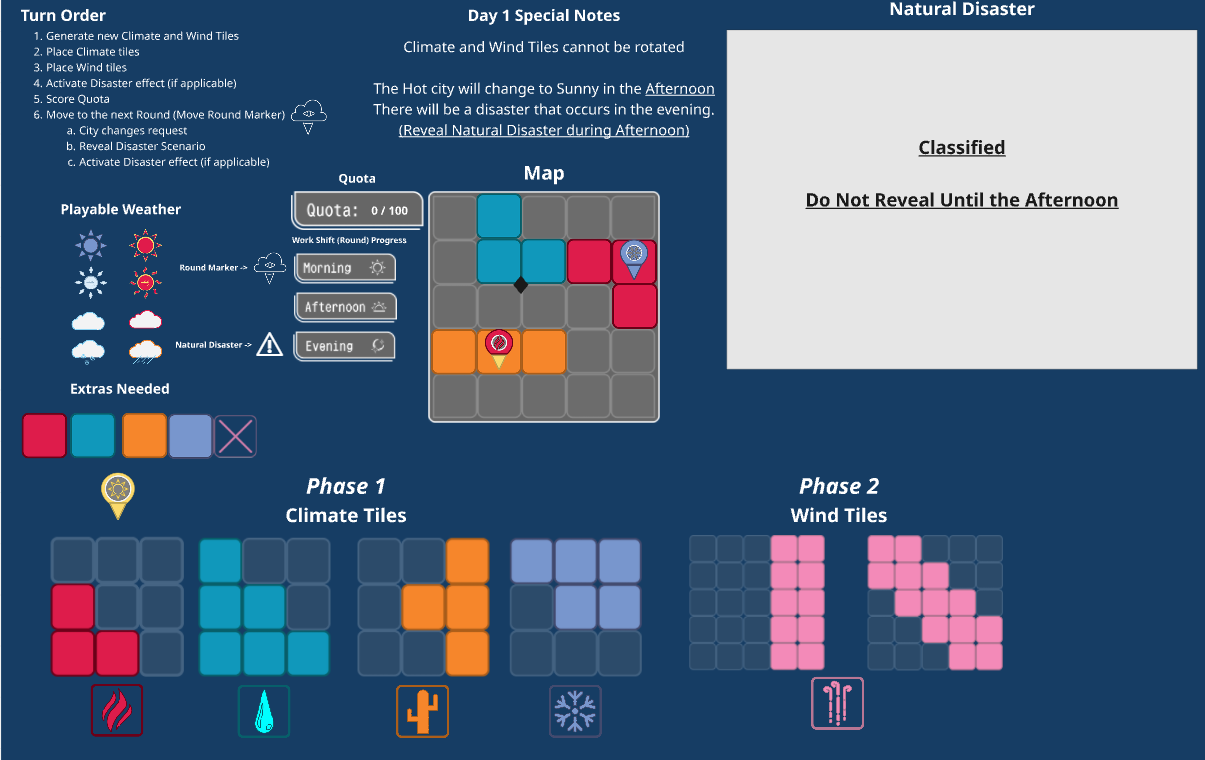
One of my biggest responsibilities for this game was to work with our programmer to create a prototype for Forecast. The issue was, we only had about a two weeks to create it. With the amount of systems that we would need to create, we opted for a virtual prototype hosted on Miro as the game’s weather management gameplay operates a bit like a board game.
The image on the right shows the beginning board state for one of our virtual prototypes. Using the instructions provided on the Miro board, players stack Climate Tiles on one another to merge them together to create weather patterns. This prototype was then used as an additional element of our game pitch that we sent to the Indie Game Foundry.
Through this process, we also tested the game with other game designers in the Indiana University Game Design Program. One of my jobs was to run the playtests, step in if players had questions, and take notes that were then used to improve the game.
Other Example Work:
This document was submitted for the Indie Game Foundry Pitch Competition. We had to provide them the slides for the pitch deck virtually.
What I learned:
This project was amazing for me to discover an introduction into game production without specifically managing a part of it at all times. I worked as a secondary producer for the team and being in that role allowed me to take a step back and take a look at the production with a bigger lens.
The importance of clear documentation. A lot of the trouble that we ran into for this project was the fact that a lot of our documentation wasn’t updated frequently, and it wasn’t clear about the direction of the game. Many of our team members were confused about the game’s design and systems as they were changing so rapidly during development. I took it on myself to update the documents as often as I could with new screenshots from the virtual prototype and information coming out of design meetings. After doing so, we had a lot less communication problems as the documentation was clearer and updated.
Navigating conflict. Working with close friends on a game is tough. There was a lot of times where each of us had conflicting ideas about direction of the game and what elements were prioritized. I focused on addressing conflict when it happened to figure out how we could move forward with the game. I learned a lot about how to have hard conversations during conflict, being sure to listen and take account for all sides, and working with the conflicting developers to find a solution to move forward.
Crunch!! Forecast had a very high turn around from the time of its inception to our goal to pitch it to the Indie Game Foundry. Because of this, it created a lot of crunch that we had to work through while many of the other devs on the team were working on their own senior projects. I mitigated as much crunch as possible by splitting up the work between each dev and reducing the amount of work for each sprint. It ended with a couple late nights with the game’s programmer and I working on the prototype. I learned that crunch can be mitigated as much as possible, but there may be periods of time where it’s difficult to prevent. When it can’t be prevented, it’s the job of the producer to support their team the best they can whether it be through working with them in-person or buying food for the team while you work through a late night. Sometimes a team has to weather through a storm, and the producer should be their shield pushing them forward.